Write your culinary software RFP in ten minutes
A free builder turns six sets of questions about your operation into a vendor-neutral RFP or RFI, complete with the response workbook procurement expects.
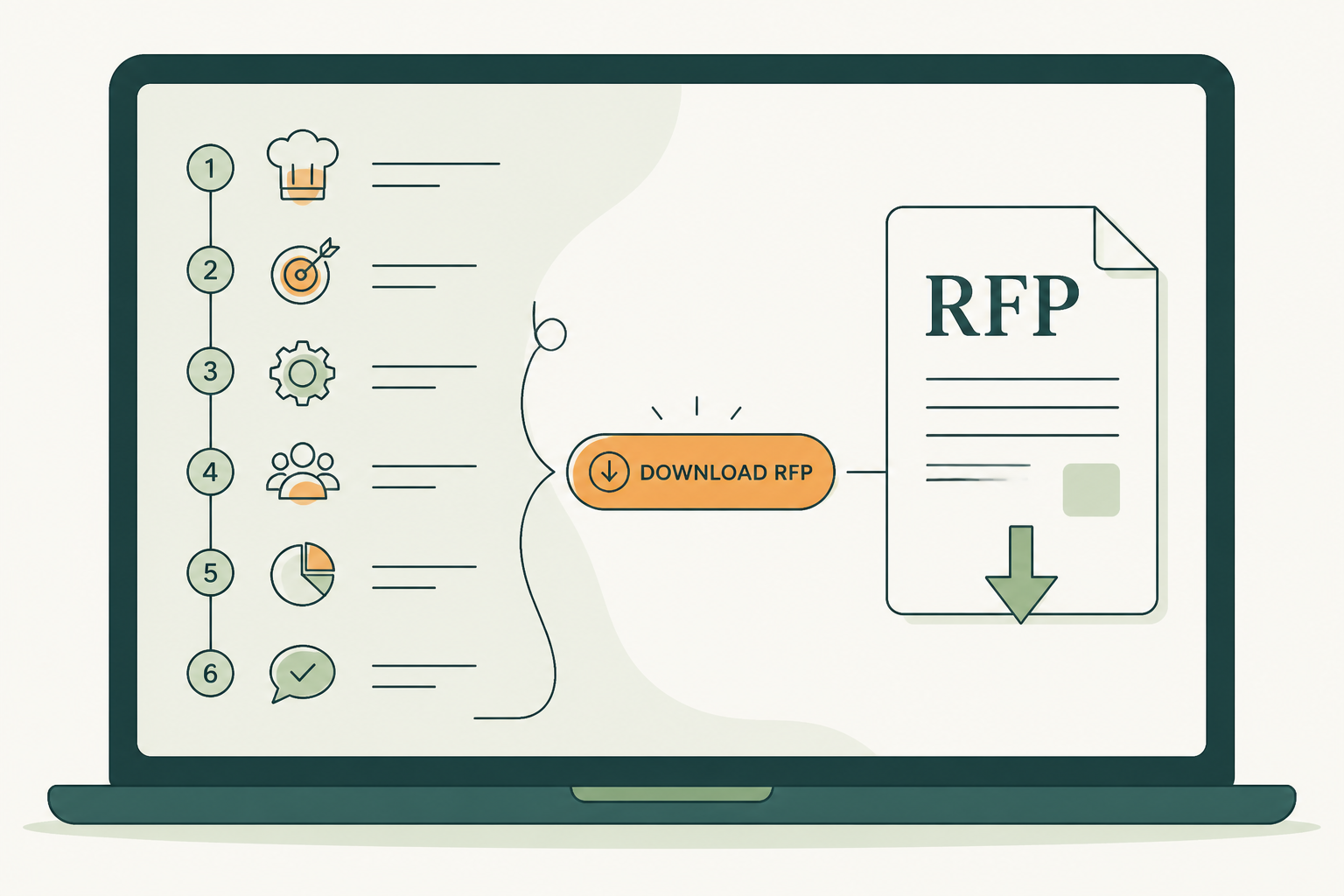
Last year we answered a university's food and beverage e-procurement RFP that arrived as a 20-tab spreadsheet. It listed more than a hundred requirements covering purchasing, inventory, accounts payable, reporting, security, and accessibility. Each was marked "Required" or "Preferred," and each called for one of three answers. A stadium operator's RFI ran to 60 requirements, with five response codes and a separate narrative section submitted through Coupa.
That's what a serious evaluation looks like. Operators writing their first one usually start from a vendor's template or a colleague's old file. They end up with either a wish list nobody can score or a feature list that reads as if the vendor wrote it.
Galley's free RFP/RFI Builder is designed to close that gap. It asks six sets of questions and produces a complete, vendor-neutral document for evaluating recipe, menu, nutrition, costing, production, purchasing, and inventory software. It's meant to be used to evaluate every vendor, Galley included.
How the Builder Works
The first questions cover your operation:
- The type of program you run
- How many locations and kitchens you have
- Whether you operate a commissary, catering, retail, or concessions
- Which systems you use today
From there, you set your goals and choose the areas in scope, giving each a priority. You also list the systems the new software must work with and decide how the process will run, including the issue date, contract term, whether to include a pilot, and how to weight the evaluation.
The builder then assembles the RFP. It includes:
Numbered sections
Requirement matrices with priorities and response codes
An integration requirement for each system you named
Narrative questions on implementation and support
A scripted demonstration and a pricing template
Evaluation weights and a schedule built from your issue date
Everything downloads as an editable Word document, along with an Excel response workbook that has one row per requirement.
Where the Requirements Come From
The builder draws on a library of 130 requirements modeled on documents real buyers have issued. These include university e-procurement and menu-management RFPs, a venue operator's inventory and recipe RFI, and the response workbooks that accompanied them. The builder filters that library by your segment, scope, and systems. A hospital sees diet-office and therapeutic-menu requirements, a stadium sees stand sheets and event reconciliation, and a K-12 district sees USDA meal-pattern compliance. No one gets all 130.
The builder also includes sections buyers often leave out:
A realistic schedule with a question period and a finalist stage.
A scripted demo that asks each vendor to import ten of your recipes live, change a supplier price, and show every affected menu re-costing.
A pricing table that covers the full contract term, leaving no room for fees that surface after award.
IT questions on security, accessibility, and AI governance. Your IT team will raise these anyway, and it's better to ask them in the RFP than three weeks into the evaluation.
An Honest Scorecard
Once you've downloaded your document, the builder's last step scores the Galley platform against your RFP line by line, using the weights your RFP publishes. It also compares the results with other types of solutions, including legacy institutional suites, restaurant back-office tools, recipe point solutions, and spreadsheets. Roadmap items never count as available. Any required items the platform doesn't meet today are listed first, so you know what to probe in the demo. Where another category of solution is typically stronger, the report says so.
Galley tends to score well because these requirements call for a single system of record. Most culinary RFPs still describe five disconnected tools: a recipe database, a nutrition program, costing spreadsheets, an ordering portal, and a count sheet. The Galley CRP platform is built as one food-data foundation that every recipe, menu, label, order, and count draws from. The scorecard will still tell you where it isn't the right fit.
RFP or RFI?
Issue an RFI when you're surveying the market and want to know what's available. It asks only for capabilities and indicative pricing. Issue an RFP when you're ready to choose a vendor. It adds binding pricing, evaluation criteria, the scripted demonstration, and contract terms. The builder can produce either one from the same answers, and nothing you enter leaves your browser until you generate the document.
The builder is free here, and the downloaded documents carry no Galley branding. If you'd like to see the platform run your scripted demo on ten of your own recipes, book a walkthrough.