The Holiday Menu, Then and Now
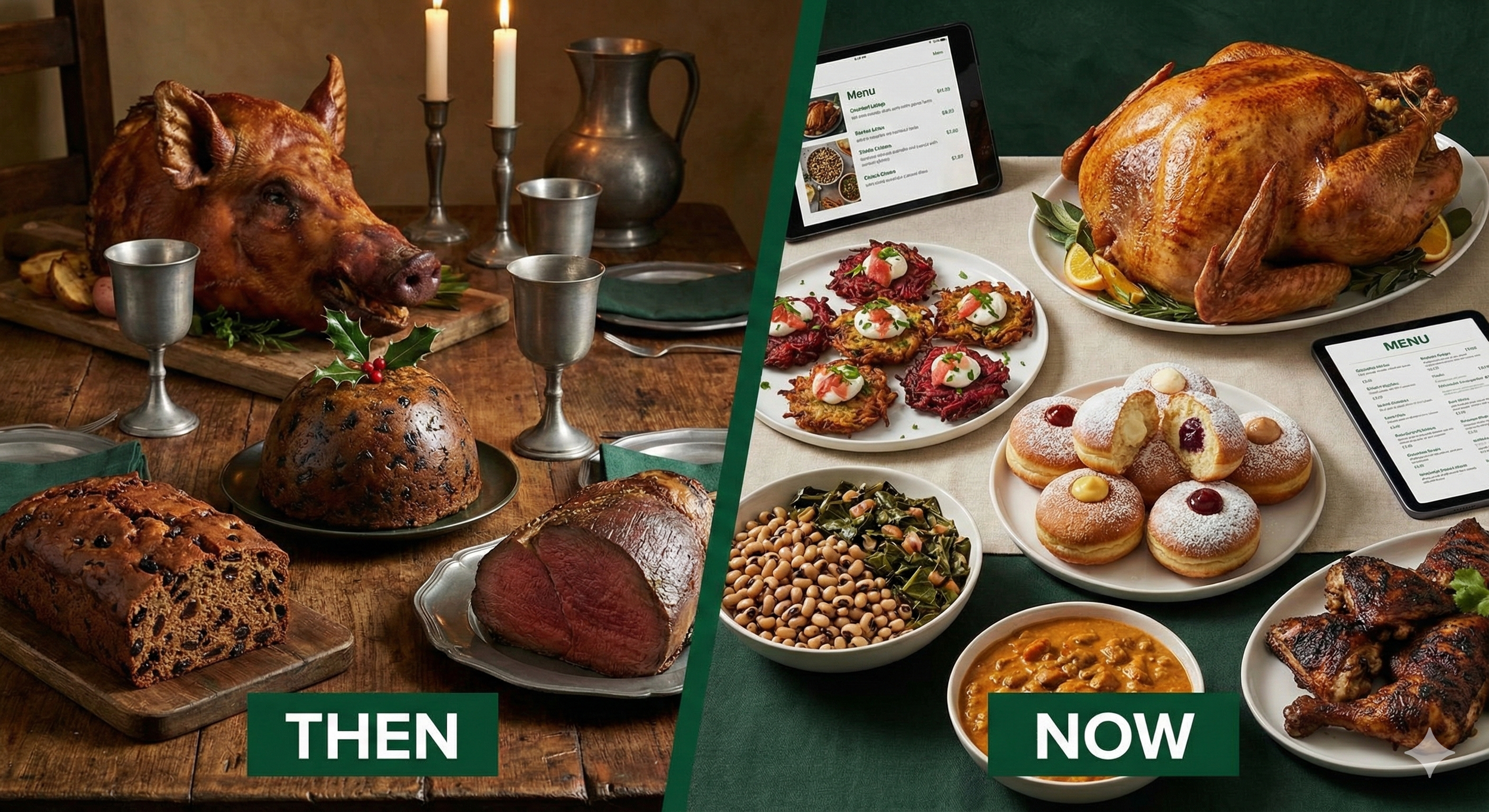
Across the holiday season, the calendar fills with celebrations that all involve food—but they do not all ritualize eating in the same way that Thanksgiving does. Thanksgiving in the United States has settled into a boringly fixed script: turkey, stuffing, mashed potatoes, cranberry sauce, and pie—often repeated year after year with only minor variations. (Is there anyone who been spared the green bean casserole or the sweet potatoes with marshmallows on top?) Christmas, Hanukkah, and Kwanzaa, by contrast, share a deep sense of tradition but allow for more cultural variation and evolution, reflecting centuries of migration, adaptation, and reinterpretation of what it means to feast together.
The Grand Roasts of Christmas
Christmas offers perhaps the clearest example of both continuity and change. Medieval and early modern Christmas tables in Europe were dominated by grand roasts—boar’s head, venison, goose, or other large animals—served as symbols of abundance and status. These were often accompanied by spiced puddings and dense, fruit-studded breads. Over time, as turkey became more affordable and widely available in Britain and, later, the United States, it displaced older centerpieces and became the “traditional” Christmas bird for many families, despite the tradition being only a few centuries old. In other regions, fish, ham, or carp remain central. And Italian American communities developed their own distinct expression with the “Feast of the Seven Fishes” on Christmas Eve. The Christmas feast, in other words, is ritualized—but the ritual itself looks very different from country to country, and it has never been as tightly standardized as the modern American Thanksgiving plate.
Hanukkah’s Food Is Miraculous
Hanukkah ritualizes food in a different way, tying what is eaten directly to the holiday’s core miracle story. The focus is not on a single, set menu but on a cooking method: frying in oil to commemorate the oil that, according to tradition, burned for eight days in the rededicated Temple. Latkes—potato pancakes fried crisp in oil. Then there’s “sufganiyot,” jelly-filled doughnuts that have become an iconic Hanukkah food, each bite doubling as both comfort and commemoration. Historically, fried dairy fritters and other regional specialties filled this role. But as Jewish communities moved and resettled, especially in Europe and North America, new ingredients and techniques reshaped the menu. Today, chefs riff on these staples with everything from beet or zucchini latkes to sufganiyot stuffed with inventive fillings, showing how ritual can remain anchored in meaning even as the actual dishes evolve.
Kwanza’s Many Culinary Traditions
Kwanzaa, a relatively recent holiday created in the 1960s, frames its main feast—the Karamu, typically held on the sixth night—as a celebration of African diasporic foodways and the “first fruits” of the harvest. Rather than a single codified menu, the Karamu table brings together dishes that reflect African, Caribbean, and African American culinary traditions: jollof rice, African peanut stews, fried or jerk chicken, black-eyed peas, collard greens, okra, yams, and a variety of fruit- and grain-based dishes tied symbolically to abundance, resilience, and community. The feast is ritualized through symbolism and shared meaning more than through a rigid set of required dishes, inviting families and communities to interpret the core principles of Kwanzaa through the specific flavors and recipes that speak to their histories.
Celebrating Food Technology
Historically, across all these holidays, feasting was shaped by what was local, seasonal, and celebratory, with little concern for standardized recipes, nutritional data, or allergen labeling. Meat was often preserved or slaughtered at specific times of year, breads and puddings reused precious grains and dried fruits, and cooks relied on memory and practice rather than gram-precise formulas. In contrast, modern foodservice operators—whether they are preparing a Christmas buffet in a hotel, a Hanukkah celebration in a community center, or a Kwanzaa Karamu for a hundred guests—must navigate a thicket of expectations and constraints: cultural authenticity, dietary restrictions, allergens, labor planning, costs, and sustainability. The ritual is still there, but it now includes spreadsheets, sourcing contracts, and regulatory compliance alongside candles, carols, and shared stories.
That is why this season, many chefs and foodservice teams are quietly celebrating the technology that sits behind the scenes. Platforms such as Culinary Resource Planning (CRP) let them translate centuries of evolving tradition into scalable, safe, and creative menus—capturing recipes with cultural nuance, tracking allergens for latkes and doughnuts, forecasting demand for a Christmas roast, or planning the complex, cross-cultural spread of a Kwanzaa Karamu. Where historical cooks trusted instinct and the rhythms of the agricultural year, today’s operators marry that same hospitality mindset with digital tools that keep guests safe, budgets on track, and teams focused on the joy of the meal. The result is that the winter holiday table, in all its diverse forms, feels as rich and meaningful as ever—only now supported by systems that help ensure everyone can gather, eat, and celebrate together.
From all of us at Galley, however and wherever you gather this season, we wish you a holiday filled with good food, shared stories, and the kinds of meals that turn tradition into memory.