

CALIFORNIA SB68 · ADDE ACT · EFFECTIVE JULY 1, 2026
Nine allergens. Every menu.
One source of truth.
On July 1, 2026, every California chain restaurant with 20+ locations must disclose nine major food allergens on every menu — printed, digital, kiosk, QR, and beyond. The Galley culinary operating system turns recipes, ingredients, and allergens into the compliant data layer powering every guest surface.


Local health inspectors begin visual verification on day one.
Trusted by enterprise foodservice operators managing recipes, menus, nutrition, and allergens across thousands of locations.
Does SB68 apply to your business?
Answer three questions. Get an instant readiness snapshot.
Allergen data is everywhere — and nowhere.
Most operators already have allergen information. It's just trapped in the wrong places.
For most foodservice operators, allergen information lives across PDFs, recipe binders, spec sheets, spreadsheets, vendor portals, point-of-sale notes, franchise overrides, and a dozen disconnected menu systems. When the rules change, every one of those systems has to change with them.
SB68 doesn't just require new data. It requires trustworthy, current, consistent data across every guest surface — every menu, every kiosk, every QR code, every printed allergen card. Inconsistency between surfaces is the compliance risk.

Senate Bill 68 — the Allergen Disclosure for Dining Experiences Act — was signed into law on October 13, 2025, and takes effect July 1, 2026. Here's what covered operators have to do.
What California SB68 (the ADDE Act) actually requires

Nine Major Allergens
Disclose the FDA "Top 9" on every menu item. Milk, eggs, fish, crustacean shellfish, tree nuts, peanuts, wheat, soybeans, and sesame — for every standard menu item, wherever you sell it.

Two Permitted Formats
Disclose on the menu — or digitally with a written backup. SB 68 allows allergen statements directly next to each menu item, OR via a digital format (such as a QR code) — provided you also offer a written alternative like a printed allergen chart, grid, or booklet.

Every Guest Surface
Printed menus, menu boards, kiosks, drive-thru, web, apps, third-party. "Menu" is defined broadly. If a guest can order from it, allergens must be disclosed on it or via the permitted digital + written alternative.

Who's Covered
20+ locations nationwide with at least one in California. The threshold counts total US locations, not California locations alone. If you operate 20+ under substantially the same brand and menu, with one in California, you're covered.

Enforcement
Local health departments. Visual verification. Day one. Local enforcement officers (Registered Environmental Health Specialists) will verify compliance through routine inspections starting July 1, 2026. Verification is by visual inspection of menus and digital surfaces.

What's at Stake
Misdemeanor exposure. Civil penalties. Permit risk. Violations are classified as misdemeanors under the California Retail Food Code. Civil penalties can range from $500 to $2,500 per violation, with repeat offenses risking permit suspension — multiplied across every covered location.
Compact mobile food operations, non-permanent facilities, prepackaged foods, and highly refined oils derived from listed allergens are exempt. Always consult counsel for your specific structure.
SB68 compliance is a food data problem. Solve the data layer once, and every guest surface follows.
Your recipes shouldn't live in PDFs
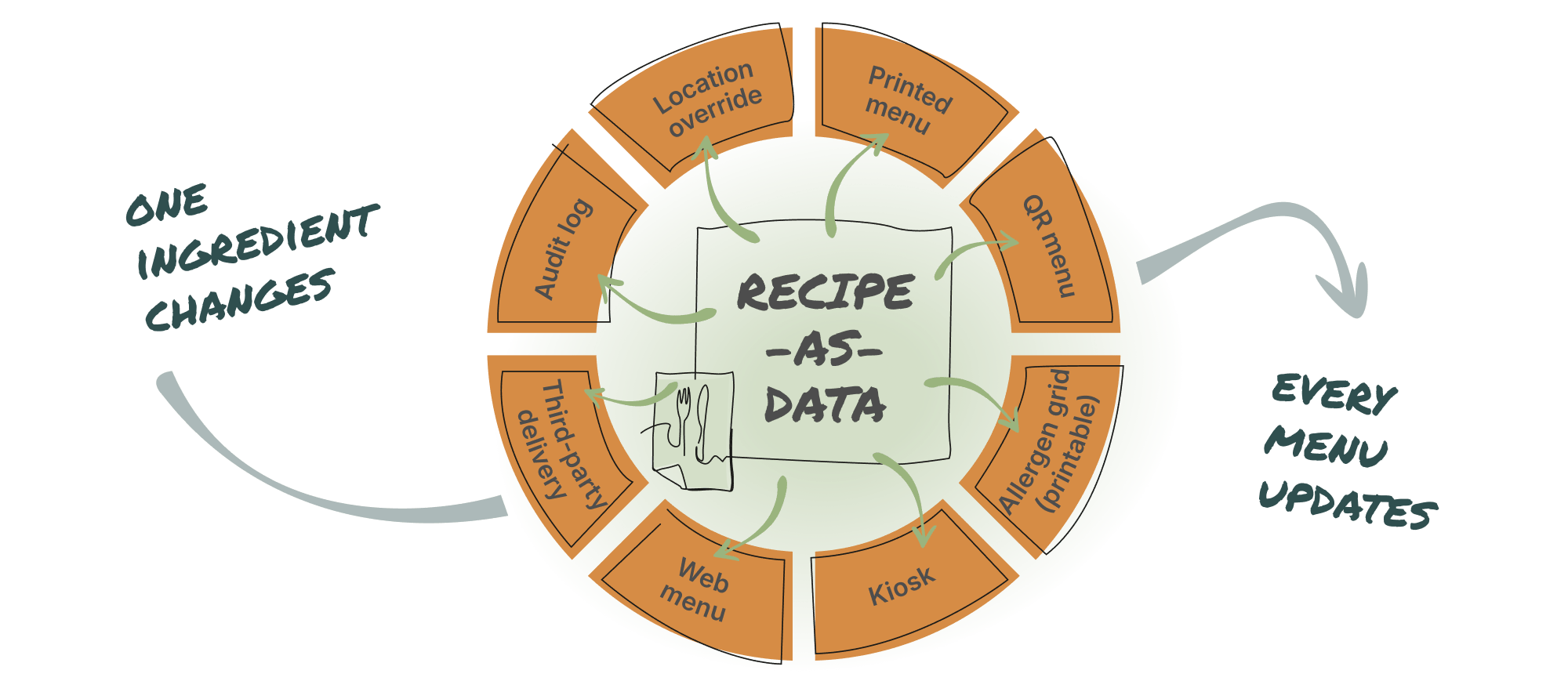
The Galley culinary operating system structures the data already running your business — recipes, ingredients, allergens, nutrition, purchasing, and production — into one operational source of truth. When an ingredient changes, every connected surface stays current: QR menus and digital recipe pages, templatized print outputs, and any customer website, app, or display pulling live data through the Galley platform's open API and webhooks.
Operators who've already invested in nutrition labeling, recipe specs, or menu management systems are sitting on fragmented compliance workflows. Galley CRP brings them together.
Built to make allergen disclosure operational
Six capabilities that turn SB68 from a deadline into a quarterly process.

Recipe-as-Data
Architecture
Every ingredient, sub-recipe, and prep step structured and reusable. Allergens propagate automatically from raw ingredient to finished dish.

QR Menus
& Digital Recipe Pages
Dynamic guest-facing menus and recipe pages with full allergen and nutrition visibility, generated from the same recipe data.

Customizable,
Templatized Outputs
Print-ready documents built from structured recipe data using customizable templates — tailored to the written formats your operation needs.

Multi-Location & Franchise
Governance
Brand-wide standards with location-level overrides, approval workflows, and franchise-aware permissioning.

Nutrition
+ Allergen in One System
Federal menu labeling and SB 68 disclosure aligned on the same recipe specs. One workflow, two regulatory wins.

Audit Logs
& Version History
Track who changed what, when, and where — the receipts inspectors and legal teams will look for.
See it in action
Compliance is the floor. Trust is the ceiling
Operators who solve the data layer get more than a clean inspection.
Reduce Operational Risk
Eliminate inconsistent allergen information across menus and locations. Cut the time culinary, ops, and marketing teams spend reconciling spreadsheets.
Earn Guest Trust
Diners with dietary restrictions are loyal to brands that make them feel safe. Clear, consistent allergen disclosure drives repeat visits — across every guest who's ever had to ask "is this safe to eat?"

Build a National-Ready Stack
SB 68 is the first state allergen disclosure law — not the last. The data system that handles California will handle whatever comes next.
"Most national chains prefer consistency across states. Practices adopted to meet California's ADDE requirements will likely become the de facto national standard."
— Industry counsel on SB68 implementation

Built for operators with real complexity
Especially valuable for organizations managing multiple ordering surfaces, rotating menus, decentralized recipe ownership, and existing nutrition compliance workflows.








Is your organization SB68 ready?
SB68 compliance is a food data problem. Solve the data layer once, and every guest surface follows.
Four questions. Two minutes. A clear picture of where you stand before July 1.
Operators who've already invested in nutrition labeling, recipe specs, or menu management systems are sitting on fragmented compliance workflows. Galley CRP brings them together.
Trusted across complex foodservice
200+
customers operating on Galley CRP
1M
490K+ recipes structured as data
200M+
menu items served from Galley recipe data
Frequently asked questions about SB68 and the ADDE Act
Disclaimer: The information provided on this page is for general informational purposes only and does not constitute legal advice. SB68 requirements and interpretations may vary based on your specific circumstances. Please consult qualified legal counsel regarding compliance obligations applicable to your organization.
July 1 isn't going to wait.
SB68 compliance will require coordination across culinary, ops, nutrition, marketing, and technology. The Galley culinary operating system centralizes the food data already running your business and turns it into compliant guest experiences — on every surface, every day.
Get ahead of
July 1, 2026, is the compliance deadline; prepare now.
Built for modern foodservice operations, managing recipes, menus, nutrition, allergens, purchasing, and production from a single source of truth.