California SB 68 Compliance Guide: What Restaurant Chains Need to Know Before July 1, 2026
If your restaurant brand operates 20 or more locations—including locations outside California—SB 68 should already be on your compliance roadmap.
Beginning July 1, 2026, California's new allergen disclosure law requires covered chain restaurants to provide written information identifying the nine major food allergens contained in each standard menu item that the restaurant knows, or reasonably should know, are present. For operators covered by the federal menu labeling law, SB 68 introduces a new operational requirement that reaches well beyond updating menus.
Many restaurant groups assume SB 68 is simply a menu project. In reality, it's a recipe and data governance project.
The restaurants that navigate the law most effectively won't necessarily have the largest regulatory teams. They'll have the cleanest operational data.
What Is California SB 68?
Senate Bill 68 amends the California Retail Food Code to require chain restaurants subject to the federal menu labeling regulations to disclose major food allergens for standard menu items.
Covered restaurants may provide allergen information in several ways, including:
Directly on printed or digital menus
Through a QR code or other digital access point
By another written method available to guests
If digital disclosure is used, restaurants must also make the information available in an alternative written format for guests who cannot access the digital version.
The law takes effect July 1, 2026.
Which Restaurants Must Comply With SB 68?
SB 68 generally applies to restaurants that are already covered by the federal menu labeling rule under the Affordable Care Act:
Restaurant chains with 20 or more locations
Locations operating under the same brand name
Restaurants offering substantially the same menu items
For multi-state restaurant groups, a chain doesn't need 20 California locations to be covered. If the organization meets the federal threshold and operates locations in California, those California restaurants are generally subject to SB 68.
Why SB 68 Is Really a Recipe Management Challenge
The law requires allergen disclosure.
It doesn't tell restaurants how to manage recipes, ingredients, supplier substitutions, menu changes, or nutrition records.
That's where the real work begins.
Every allergen disclosure ultimately depends on the accuracy of the underlying recipe. If the recipe changes, the allergen information may change. If procurement approves a substitute ingredient, the allergen profile may change. If marketing renames a menu item, that new name still has to connect to the correct recipe and allergen record.
For restaurant organizations operating dozens or hundreds of locations, maintaining those relationships manually becomes increasingly difficult.
Most operators already have the necessary information. It's simply spread across multiple systems:
Recipe documents maintained by culinary
Nutrition and allergen spreadsheets
Procurement and vendor specification systems
POS and online ordering platforms
Marketing assets
Training documentation
SB 68 doesn't create that complexity.
It simply exposes it.
The Biggest SB 68 Compliance Risks
As implementation approaches, most restaurant groups discover the same operational gaps.
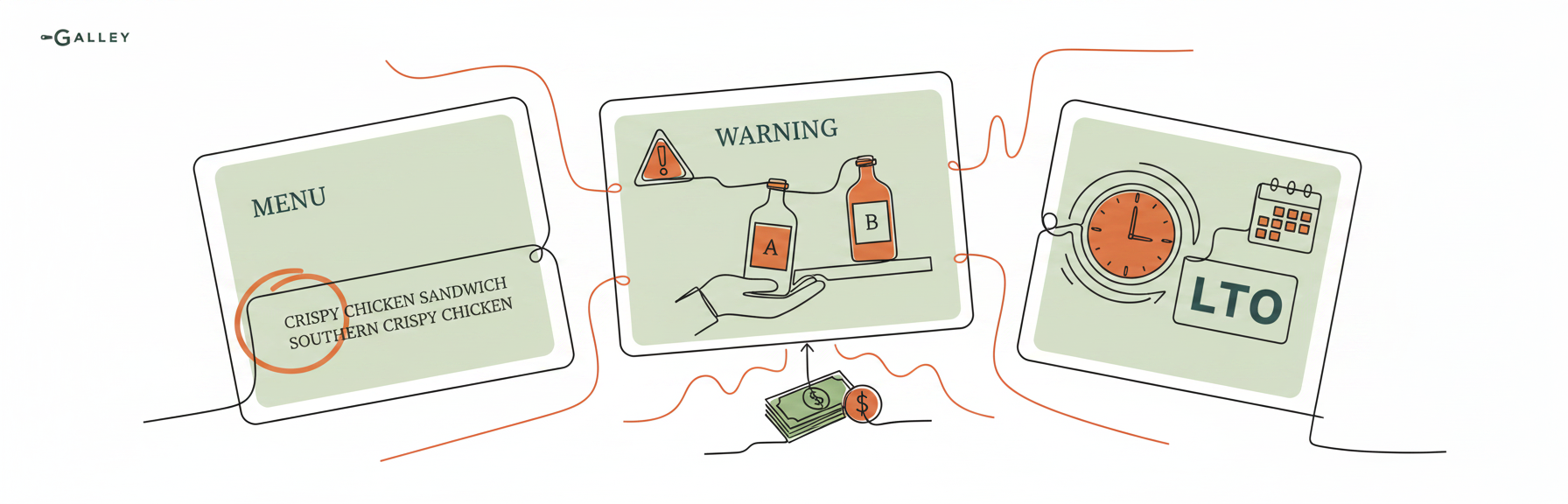
Recipe and Menu Names Don't Match
Marketing, culinary, and POS teams often refer to the same item differently. Every guest-facing menu item should map to the correct recipe and allergen record.
Ingredient Substitutions Aren't Reviewed
Supplier changes happen every day. Even when allergens don't change, restaurants need confidence that substitutions have been reviewed before updated information reaches guests.
Limited-Time Offers Move Too Fast
Promotional menus often bypass normal documentation workflows. If an LTO qualifies as a standard menu item under federal menu labeling rules, allergen information should be ready before launch—not after.
Multiple Systems Contain Different Versions of the Truth
Recipes live in one system.
Nutrition lives in another.
Procurement owns ingredient specifications.
Marketing owns menu language.
Operations owns execution.
Without a shared source of truth, every menu change introduces additional compliance risk.
An SB 68 Compliance Checklist
Before July 1, restaurant leaders should be able to answer "yes" to these questions.
Can every California menu item be connected to a current recipe?
Can every ingredient and sub-recipe be evaluated for the nine major allergens?
Does your organization review supplier substitutions before menu information is updated?
Are menu names synchronized across POS, online ordering, recipes, and marketing?
Are promotional menu items reviewed before launch?
Can you document when allergen information was last updated?
Is ownership clearly defined for approving allergen information?
If any of those answers is uncertain, that's where your compliance work should begin.
Building a Sustainable SB 68 Compliance Process
Preparing for SB 68 isn't about producing one perfect spreadsheet before the deadline.
It's about building a process that continues to work after the law takes effect.
Restaurant menus change constantly. Vendors substitute ingredients. Recipes evolve. Seasonal promotions launch every few weeks. Every operational change has the potential to affect allergen disclosures.
The organizations that stay ahead of compliance won't rely on disconnected spreadsheets or annual audits. They'll maintain recipe data as an operational system that's continuously updated as menus evolve.
That's why more restaurant groups are moving toward recipe-first culinary resource planning. When recipes become the system of record, nutrition analysis, allergen management, costing, procurement, and menu planning all draw from the same data. Teams spend less time reconciling spreadsheets and more time managing change with confidence.
Not sure if your organization is SB 68 ready?
The deadline is approaching quickly, and for many restaurant chains the work isn't creating allergen disclosures—it's validating the data behind them.
Galley's SB 68 Readiness Assessment helps restaurant operators identify operational gaps before they become compliance problems. In just a few minutes, you'll understand where your recipes, ingredient data, menu workflows, and allergen processes stand—and what to prioritize before July 1. Or, if you'd rather talk it through, schedule a conversation with one of our compliance specialists click here to schedule a demo.